
Have you ever wondered why two people born on the same day can have such completely different lives? Or why you sometimes feel mysteriously drawn to certain paths, certain careers, relationships. If questions like these have ever crossed your mind, these may not be solved by Numerology you may be knocking on the door of Vedic astrology.
Vedic Astrology known as Jyotish in Sanskrit, which literally means “Science of Light”. It is one of the world’s oldest and most sophisticated systems for understanding human life. Vedic Astrology is deep mathematcis precise framework developed in ancient India 5000 years ago. It is still actively used by millions of people across the world today — not just for curiosity, but as a practical tool for making important life decisions.
Contents
What is Vedic Astrology?
Vedic astrology is the study of how the positions of planets and stars at the exact moment of your birth create a unique “cosmic fingerprint” that influences your personality, your strengths and challenges, your relationships, your health, and the timing of major life events. Vedic astrology reads this photograph and interprets what it means for your life journey. This cosmic snapshot is called your birth chart or Kundali.
Where did Vedic Astrology (Jyotish) Come from?
Vedic astrology is one of the six Vedanga, (Shiksha, Kalp, Nirukt, Chhand, Vyakaran, Jyotish) the six auxiliary disciplines of the Vedas, the ancient sacred texts of India. The Vedas are among the oldest written works in human history, and Jyotish was considered essential knowledge for understanding cosmic time and scheduling sacred rituals.
According to ancient tradition, the profound science of Jyotish did not begin with written texts, but originated as divine knowledge. It was first revealed by Lord Shiva, who imparted the cosmic secrets of the universe to Goddess Parvati. This wisdom was then passed to Lord Kartikeya, who subsequently transmitted it to the great Rishis.
The knowledge was then carried across the subcontinent by these highly elevated sages. In North India, Maharishi Bhrigu became the primary disseminator of this divine astrological wisdom, while in South India, the teachings were established and spread by Maharishi Agastya.
Over centuries, other great sages and scholars including Varahamihira, Kalyana Varma, and Mantreswara refined and expanded the system, producing classics like Brihat Jataka, Saravali, and Phaladeepika that remain essential reading for any serious student of Jyotish.
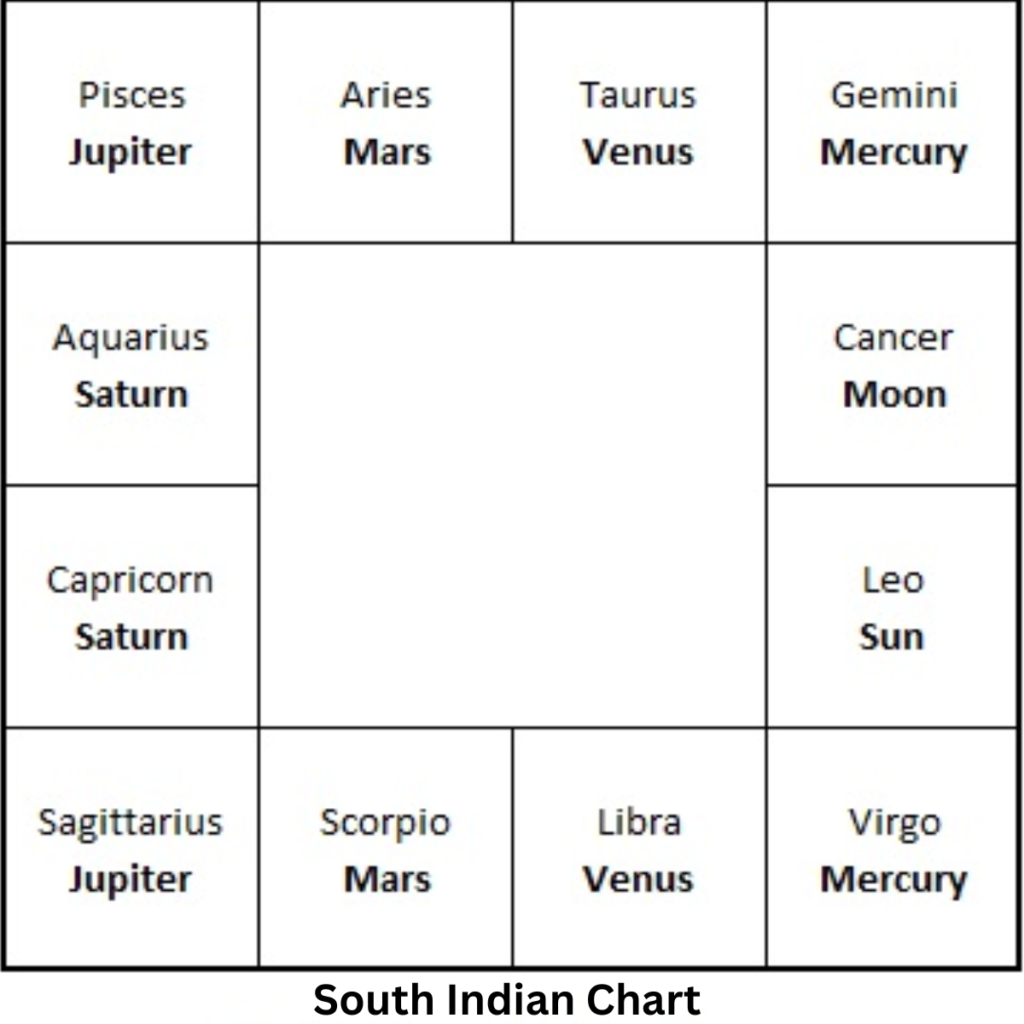
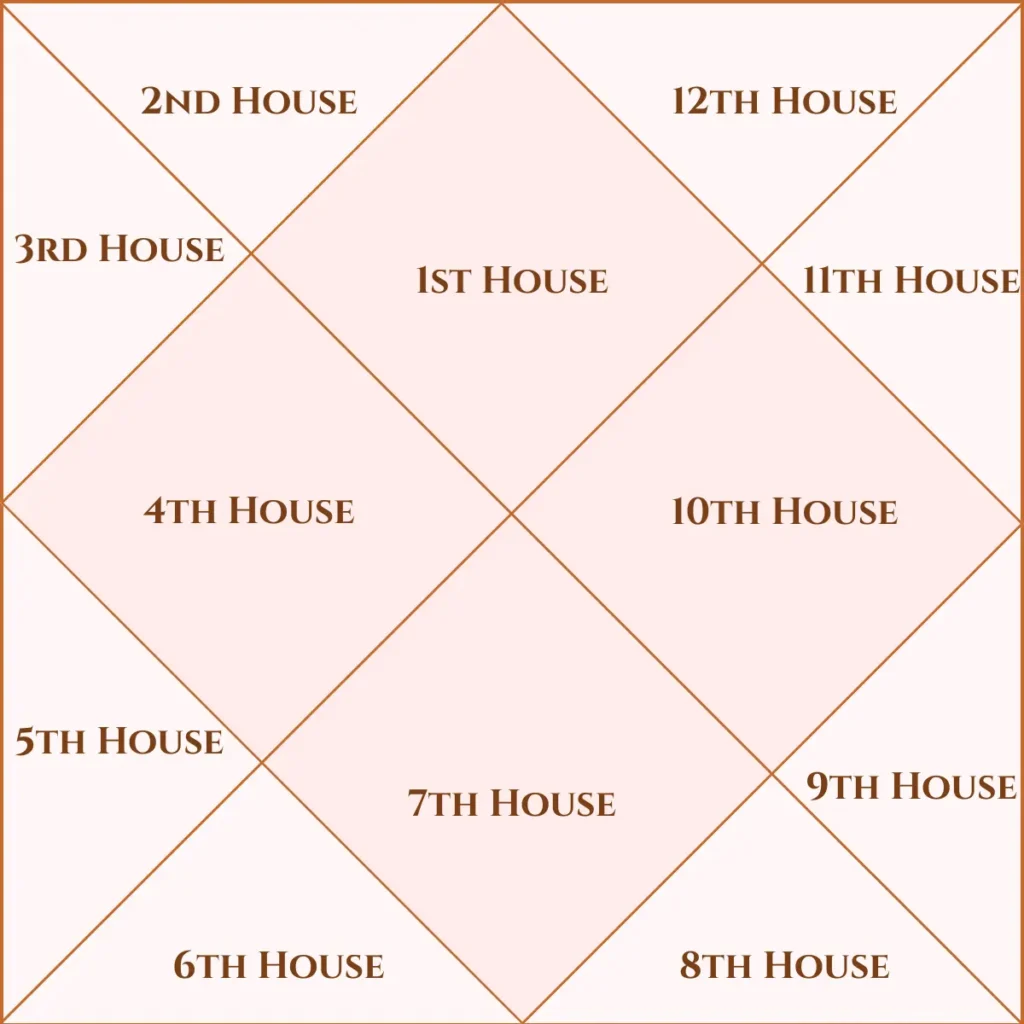
North Indian and South Indian Chart Style
The Nine Planets of Vedic Astrology (Navagrahas)
In Vedic astrology, nine celestial bodies called Grahas are used. Vedic astrology does not traditionally use the outer planets Uranus, Neptune, or Pluto. Instead, it uses two special mathematical points called Rahu and Ketu, the Moon’s nodes.
Each planet governs specific areas of life, has a natural character, and influences the chart differently depending on its sign, house, and relationships with other planets
| Planet | Sanskrit Name | Rules Sign | Key Qualities |
|---|---|---|---|
| Sun | Surya | Leo | Soul, ego, father, authority, vitality, leadership |
| Moon | Chndra | Cancer | Mind, emotions, mother, comfort, instincts, nourishment |
| Mars | Managla | Aries, Scorpio | Energy, courage, ambition, conflict, drive, siblings |
| Mercury | Budha | Gemini, Virgo | Intelligence, communication, business, learning, skin |
| Jupiter | Brihaspati | Saggitarius, Pisces | Wisdom, expansion, grace, children, spirituality, wealth |
| Venus | Shukra | Taurus, Libra | Love, beauty, creativity, luxury, relationships, arts |
| Saturn | Shani | Capricorn, Aquarius | Discipline, karma, longevity, delays, hard work, obstacles |
| Rahu (North Node) | Rahu | Co-rules Aquarius | Obsession, foreign things, worldly desire, innovation, illusion |
| Ketu (South Node) | Ketu | Co-rules Scorpion | Spirituality, past lives, liberation, detachment, intuition |
Benefic and Malefic Planets
Planets in Vedic astrology are broadly categorized as natural benefics (those that generally bring good results) and natural malefics (those that can bring difficulty, but also discipline and strength).
✦ Natural Benefics: Jupiter, Venus, Mercury (when not afflicted), and the waxing Moon (bright Moon, above half full)
✦ Natural Malefics: Saturn, Mars, Rahu, Ketu, the Sun (mildly), and the waning Moon (dark Moon)
It is important to understand that malefic planets are not “evil.” Saturn, for instance, is the planet of karma, discipline, and hard work. Its difficult periods often produce the most meaningful growth. Similarly, Mars gives courage, drive, and the ability to take decisive action. A chart without strong malefics often lacks the resilience and determination to achieve major goals.
The Twelve Zodiac Signs (Rashis)
The Vedic zodiac has the same twelve signs as Western astrology, though their character and interpretation can differ. In Sanskrit, the signs are called Rashis. Each sign has a ruling planet, an element, a quality, and a fundamental nature. Here is a friendly overview of all twelve:
Aries (Mesha) — The Pioneer
Ruling Planet: Mars | Element: Fire | Quality: Movable (Cardinal)
Mesha is bold, energetic, and pioneering. People with strong Aries placements are often natural leaders who love to start new things. They are courageous and direct, sometimes impulsive. Life lessons often involve learning patience and finishing what they begin.
Taurus (Vrishabha) — The Builder
Ruling Planet: Venus | Element: Earth | Quality: Fixed
Vrishabha is stable, sensual, and persistent. These individuals love beauty, comfort, and creating lasting things. They can be stubborn, but also incredibly reliable. Venus’s influence gives them an appreciation for art, food, music, and all of life’s finer pleasures.
Gemini (Mithuna) — The Communicator
Ruling Planet: Mercury | Element: Air | Quality: Dual (Mutable)
Mithuna is curious, communicative, and versatile. These individuals are quick thinkers who love to learn and share information. They can sometimes seem scattered because their minds move so quickly, but they are gifted at seeing multiple sides of any situation.
Cancer (Karka) — The Nurturer
Ruling Planet: Moon | Element: Water | Quality: Movable (Cardinal)
Karka is sensitive, nurturing, and deeply connected to home and family. Moon-ruled Cancer individuals feel life deeply and have powerful instincts. They are protective of those they love and often have strong emotional intelligence.
Leo (Simha) — The Royalty
Ruling Planet: Sun | Element: Fire | Quality: Fixed
Simha is regal, creative, and naturally commanding. Sun-ruled Leo individuals have a natural charisma and love for self-expression. They are generous, warm, and often drawn to leadership, performance, or positions of authority.
Virgo (Kanya) — The Analyst
Ruling Planet: Mercury | Element: Earth | Quality: Dual (Mutable)
Kanya is precise, analytical, and service-oriented. These individuals have a gift for seeing detail and improving systems. They can be their own harshest critics, but this perfectionist energy also makes them excellent at their craft — whatever that may be.
Libra (Tula) — The Diplomat
Ruling Planet: Venus | Element: Air | Quality: Movable (Cardinal)
Tula is balanced, harmonious, and relationship-oriented. Venus gives these individuals a natural charm and love of fairness. They are gifted mediators and often deeply concerned with justice, beauty, and creating win-win situations.
Scorpio (Vrishchika) — The Transformer
Ruling Planet: Mars (and co-ruled by Ketu) | Element: Water | Quality: Fixed
Vrishchika is intense, transformative, and deeply perceptive. Scorpio individuals have an ability to go beneath the surface of things that can be both a gift and a burden. They are drawn to mystery, depth, and the hidden dimensions of life.
Sagittarius (Dhanu) — The Seeker
Ruling Planet: Jupiter | Element: Fire | Quality: Dual (Mutable)
Dhanu is philosophical, adventurous, and expansive. Jupiter-ruled Sagittarius individuals are seekers of truth — whether through travel, religion, philosophy, or higher education. They are optimistic and inspiring, though they can sometimes overpromise.
Capricorn (Makara) — The Achiever
Ruling Planet: Saturn | Element: Earth | Quality: Movable (Cardinal)
Makara is disciplined, ambitious, and patient. Saturn’s influence gives these individuals tremendous staying power and the ability to build lasting structures — careers, institutions, legacies. They often improve with age, getting better as they get older.
Aquarius (Kumbha) — The Visionary
Ruling Planet: Saturn (and co-ruled by Rahu) | Element: Air | Quality: Fixed
Kumbha is innovative, humanitarian, and unconventional. These individuals often feel ahead of their time and are drawn to social reform, technology, and alternative ways of thinking. They are independent thinkers who value community.
Pisces (Meena) — The Mystic
Ruling Planet: Jupiter | Element: Water | Quality: Dual (Mutable)
Meena is compassionate, imaginative, and spiritually sensitive. Jupiter gives these individuals a boundless inner world and deep empathy. They are often artistic, intuitive, and drawn to spiritual practice — though they must learn healthy boundaries
The Twelve Houses (Bhavas)
In Vedic astrology, there are twelve houses, each representing a specific domain of life. The houses are counted from the Ascendant (Lagna), which occupies the first house. Here is what each house governs:
1st House (Lagna) — Self, physical body, appearance, personality, life path, overall vitality
2nd House — Family, speech, wealth, food, values, early education, the face and mouth
3rd House — Siblings, courage, communication, short travels, hands, media, hobbies, neighbors
4th House — Mother, home, land, happiness, vehicles, education, the heart and inner peace
5th House — Children, creativity, romance, intelligence, past life merit, speculation, education
6th House — Health, enemies, debts, service, daily work, legal matters, pets, competition
7th House — Marriage, partnerships, business partners, open enemies, foreign lands, contracts
8th House — Death, transformation, inheritance, hidden things, occult, longevity, joint finances
9th House — Dharma (life purpose), luck, father, religion, higher education, long journeys, guru
10th House — Career, public reputation, authority, government, achievement, social status
11th House — Income, gains, friendships, social networks, desires, elder siblings, recognition
12th House — Losses, isolation, foreign lands, liberation, sleep, expenses, the unconscious, moksha
The 1st, 4th, 7th, and 10th houses are called Kendra (angular) houses — the most powerful positions in the chart. The 1st, 5th, and 9th houses are called Trikona (trine) houses — the luckiest positions. Planets placed in these houses generally thrive and give strong results in their themes.
Trik Houses: The Houses of Challenge
The 6th, 8th, and 12th houses are known as the Trik or Dusthana (difficult) houses. Planets placed here may bring challenge, obscurity, or unusual results. However, these houses are also incredibly powerful for certain purposes: the 8th house governs transformation and occult knowledge, and the 12th governs spiritual liberation. Some of the greatest mystics and healers have prominent 8th and 12th house placements.
How to Read a Birth Chart
A birth chart (Kundali or Janam Kundali) looks quite different from the circular charts used in Western astrology. Most Vedic charts use either a North Indian style (diamond-shaped boxes) or a South Indian style (a grid of squares). Both contain the same information — they are just different ways of visualizing it.
What Information do you Need?
To calculate your Vedic birth chart accurately, you need three things:
Your date of birth (day, month, year)
Your exact time of birth (as precise as possible — even 10 minutes can change the Ascendant)
Your place of birth (city and country)
With this information, a Vedic astrologer (or a free online calculator) can generate your chart showing where each of the nine planets was located at the moment of your birth.
The First Step: Identify Your Lagna (Ascendant)
The most important starting point in reading any Vedic chart is identifying the Lagna — the rising sign. This determines which sign falls in the first house, and consequently, which signs fall in all the other houses. The Lagna changes approximately every two hours, which is why birth time is so critical.
Your Lagna sign colors everything in your chart. It represents your physical body, your natural disposition, and the lens through which you experience life. A Scorpio Lagna person experiences the world very differently from a Gemini Lagna person, even if both have identical Sun and Moon signs.
The Dasha System
One of the most remarkable and practically powerful tools in Vedic astrology is the Dasha system — a system of planetary time periods that maps out the major chapters and themes of a person’s life.
The most commonly used Dasha system is called Vimshottari Dasha, which operates on a 120-year cycle divided among the nine planets. The period you are currently in — your major Dasha planet — profoundly influences the overall tone and themes of that phase of your life.
How the Dasha Cycle Works
The 120-year Vimshottari Dasha cycle is divided as follows:
Sun (Surya) Dasha: 6 years — themes of authority, vitality, ego, and father
Moon (Chandra) Dasha: 10 years — themes of emotions, mind, mother, and nourishment
Mars (Mangala) Dasha: 7 years — themes of energy, ambition, siblings, and courage
Rahu Dasha: 18 years — themes of obsession, ambition, foreign things, and upheaval
Jupiter (Guru) Dasha: 16 years — themes of expansion, wisdom, children, and grace
Saturn (Shani) Dasha: 19 years — themes of karma, discipline, hard work, and restructuring
Mercury (Budha) Dasha: 17 years — themes of intellect, communication, business, and learning
Ketu Dasha: 7 years — themes of spirituality, detachment, past life themes, and liberation
Venus (Shukra) Dasha: 20 years — themes of love, beauty, relationships, and material prosperity
Your starting Dasha at birth is determined by the Nakshatra your Moon occupies. This is one of the key reasons the Nakshatra system is so fundamental to Vedic astrology — it literally determines where you begin in the Dasha cycle.
Within each major Dasha, there are sub-periods (called Antardashas or Bhuktis) ruled by each of the nine planets in sequence. These add further layers of timing and detail. A skilled Vedic astrologer uses the interplay of major and sub-periods, along with current planetary transits, to give remarkably specific timing predictions.
Remedies in Vedic Astrology
One of the most distinctive and practically oriented aspects of Vedic astrology is the tradition of remedies — specific actions, practices, or objects that can help balance or strengthen planetary energies in your chart.
Vedic astrology has never been purely descriptive (“this is your fate”). From its earliest days, it has been prescriptive — offering practical tools to work with challenging planetary energies. Remedies fall into several categories:
Gemstones (Ratnas)
Each of the nine planets has an associated gemstone. Wearing the appropriate gemstone (set in the right metal, on the right finger, activated at an auspicious time) is believed to strengthen a benefic planet’s influence in your life. For example, wearing a yellow sapphire is associated with strengthening Jupiter, potentially bringing more wisdom, grace, and prosperity into your life. However, gemstone recommendations should be made carefully by an experienced astrologer, as wearing the wrong gemstone for your chart can amplify difficult energies.
Mantras
Reciting specific mantras associated with a planet is one of the most powerful and time-honored remedies. Mantras work by attuning the mind and nervous system to particular frequencies. For example, the Surya (Sun) mantra Om Hraam Hreem Hraum Sah Suryaya Namaha is traditionally chanted to strengthen the Sun’s energy and qualities of clarity, confidence, and vitality.
Fasting and Rituals
Each planet has an associated day of the week. Fasting on that day, or performing specific prayers and rituals, is a traditional remedy. For example, Saturdays are associated with Saturn, and many people observe fasting or visit temples dedicated to Saturn on this day as a way of propitiating this powerful karmic planet.
Chatiable Acts
Performing specific acts of charity associated with a planet’s themes is considered a powerful remedy for softening difficult planetary karma. For Saturn, for instance, charitable acts toward elderly people, laborers, or the underprivileged are recommended. For Jupiter, supporting teachers, priests, or educational causes is beneficial.
Frequently Asked Questions About Vedic Astrology
How important is birth time accuracy for a Vedic chart?
Very important. The Ascendant changes approximately every two hours, and even a 10-minute difference can shift planetary house placements. If you do not know your birth time, a skilled astrologer can sometimes perform chart rectification — using known life events to work backward to the likely birth time.
Can Vedic astrology tell me when I will get married?
Vedic astrology can identify time windows when marriage or significant relationships are more likely based on Dasha periods, transits, and the condition of the 7th house and its lord. It cannot guarantee an exact date, but many experienced astrologers make impressively accurate timing predictions in this area.
What is the difference between a Jyotishi and a regular astrologer?
A Jyotishi is a practitioner specifically trained in the Vedic or Jyotish tradition. The term implies knowledge of the classical texts, the Nakshatra system, the Dasha system, and the broader Vedic cosmological framework. The quality of practice varies enormously — as with any field, training, experience, and intuitive skill all matter.