

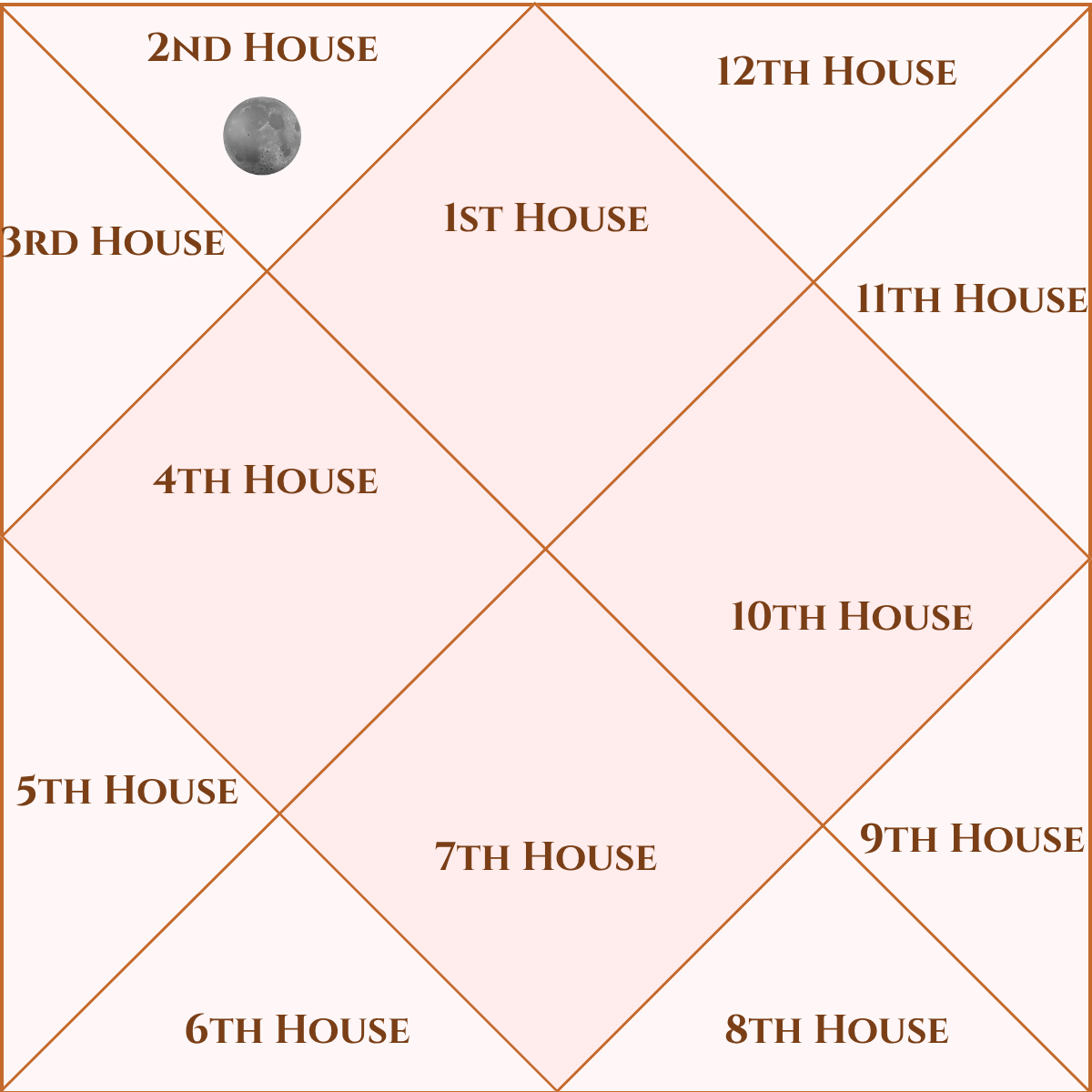
What It Means
In Vedic astrology, the First House is called the Lagna or Pratham Bhava. It represents the self, the physical body, general temperament, and the overall direction of a person’s life. When the Moon occupies this house, it places lunar qualities at the very core of the native’s identity.
The Moon in Vedic astrology governs the mind, emotions, intuition, memory, the mother, and cycles of change. Its placement in the first house means these qualities are not background influences — they become the dominant filter through which the native experiences and interacts with the world.
This is one of the more emotionally expressive placements in a chart. The native’s inner emotional state tends to be visible to others through facial expressions, body language, and overall demeanor. Unlike placements where emotions are internalized, the first-house Moon projects feelings outward.
The strength of this placement depends significantly on whether the Moon is waxing or waning at the time of birth. A waxing Moon (Shukla Paksha) in the first house is considered strong and auspicious. A waning Moon, especially near the New Moon, may create emotional sensitivity, instability, or dependency if not supported by other planetary factors.
Personality and Temperament
Natives with the Moon in the first house tend to be emotionally oriented in how they perceive and respond to situations. Rather than leading with logic or analysis, their first response to people and circumstances is emotional and intuitive.
They are generally empathetic and are often acutely aware of the emotional states of those around them. This awareness can be an asset in social and professional situations, but it also means they are susceptible to absorbing the moods and stress of their environment.
Moodiness is a recognized characteristic of this placement. Because the Moon moves faster than any other planet and continuously changes signs every two and a half days, natives with a prominent Moon tend to experience more frequent emotional fluctuations than those with more stable planetary placements in the first house.
They are adaptable and responsive to change, though this same quality can manifest as inconsistency or indecisiveness when the Moon is afflicted. They tend to rely on memory and past experience when making decisions, and often find comfort in familiar environments, routines, and people.
Nurturing is a central theme. These individuals often feel a natural pull toward caring for others — providing food, comfort, and emotional support. This instinct can express itself in personal relationships, professional life, or both.
Physical Appearance and Health
The Moon’s influence on the body produces certain recognizable physical qualities. Natives commonly have rounded facial features, a fair or light complexion, and expressive eyes. The body type tends toward softness rather than muscularity, and there may be a natural tendency to retain water weight or experience fluctuations in body weight over time.
Health concerns associated with this placement center around the chest, lungs, stomach, and digestive system — all organs associated with the Moon in classical Jyotish texts. Conditions such as indigestion, acid reflux, bloating, and respiratory sensitivities are not uncommon.
Mental and emotional health is closely linked to physical health for these natives. Prolonged stress, emotional conflict, or disrupted sleep tends to manifest in physical symptoms fairly quickly. Insomnia, anxiety, and in some cases hormonal irregularities are associated with an afflicted first-house Moon.
A notable feature of this placement is the native’s sensitivity to lunar cycles. Energy levels, mood, and even physical vitality may noticeably correspond to the phase of the Moon. Many practitioners recommend that these natives track lunar phases when planning significant activities, medical procedures, or periods of rest.
Effects by Zodiac Sign
The Moon’s expression changes depending on the sign it occupies in the first house. The following outlines its general behavior across each sign:
Aries — The native is emotionally energetic and impulsive. Reactions tend to be quick and direct. There can be impatience in emotional matters.
Taurus — The Moon is exalted here. The native is emotionally stable, patient, and deeply nurturing. There is a strong attachment to comfort, beauty, and material security.
Gemini — Emotions are expressed through communication. The native may experience duality in feelings and can shift between moods rapidly. Intellectual stimulation is emotionally necessary.
Cancer — The Moon rules Cancer, making this its own sign. The native is deeply intuitive, sensitive, and strongly connected to home, family, and the mother. This is one of the most powerful placements for the Moon.
Leo — Emotions are expressed dramatically and warmly. The native seeks recognition and appreciation. There is a strong sense of personal pride tied to emotional identity.
Virgo — Feelings are processed analytically. The native tends to overthink emotions and may struggle to express vulnerability directly. They nurture through acts of service and practical help.
Libra — The native seeks emotional balance and harmony. Emotions are heavily influenced by relationships and social environments. There is a strong need for partnership and fairness.
Scorpio — The Moon is debilitated in Scorpio. Emotions are intense, secretive, and sometimes extreme. There may be struggles with jealousy, obsession, or emotional control. Transformation through emotional crisis is a recurring theme.
Sagittarius — The native processes emotions through philosophy and optimism. There is a need for emotional freedom and space. Long-distance travel or higher learning may provide emotional fulfillment.
Capricorn — Emotions are restrained and disciplined. The native may appear detached or reserved, even when feeling deeply. Emotional expression tends to open up slowly over time.
Aquarius — The native processes emotions intellectually and may appear emotionally detached in personal relationships. They feel most emotionally engaged through social causes and collective ideals.
Pisces — The native is highly intuitive and empathetic, sometimes to the point of losing personal boundaries. There is a strong spiritual and imaginative dimension to emotional life. Isolation or escapism can be tendencies when the Moon is afflicted here.
Career and Professional Life
The first-house Moon inclines the native toward professions that involve direct human contact, care, creativity, or service to the public. The Moon’s association with the masses makes this a placement that can support public-facing careers.
Fields that align well with this placement include healthcare, nursing, psychology, counseling, social work, education, hospitality, the food and beverage industry, real estate, and domestic services. Professions connected to water — such as shipping, fishing, or marine industries — also fall under lunar rulership.
Creative fields are well-supported, particularly those that involve emotional expression. Writing, poetry, acting, music, and culinary arts are all areas where a first-house Moon native can excel by channeling emotional depth into their work.
The Moon’s connection to the public means that careers requiring mass appeal — such as politics, media, or entertainment — are also indicated, provided the Moon is well-placed and strong in the chart.
A potential professional challenge is inconsistency. Mood-dependent motivation can make sustained effort difficult during periods of emotional disruption. Developing a structured routine helps mitigate this.
Relationships and Emotional Life
In relationships, the first-house Moon native is devoted, emotionally generous, and deeply attentive to the feelings of those they care for. They tend to prioritize emotional connection over practical compatibility and may stay in relationships longer than is advisable simply because of emotional attachment.
The relationship with the mother is of particular significance. The Moon represents the mother in Vedic astrology, and its placement in the first house often indicates that the mother’s influence — in terms of both positive nurturing and any wounds — is central to the native’s emotional development. The nature of this relationship and the condition of the Moon in the chart often reflect early emotional conditioning.
These natives need partners who offer consistent emotional availability and stability. Emotional unpredictability or unavailability in a partner tends to trigger anxiety and insecurity. They are most at ease in relationships that feel safe, familiar, and emotionally honest.
A key developmental task for this placement is learning to manage emotional absorption — the tendency to take on the feelings of others as their own. Without this awareness, the native can become emotionally overwhelmed or lose a clear sense of their own emotional identity.
Vedic Remedies
Classical Jyotish prescribes the following remedies to strengthen a weak or afflicted Moon in the first house:
Mantra — Reciting the Chandra Beej Mantra, “Om Som Somaya Namah,” 108 times on Monday mornings, particularly during the waxing phase of the Moon, is a standard remedy.
Gemstone — A natural pearl (Moti) set in silver, worn on the ring finger of the right hand, is the primary gemstone for the Moon. This should only be adopted after consultation with a qualified Jyotishi, as gemstone prescriptions depend on the full chart.
Colour — Wearing white, silver, or cream, particularly on Mondays, is said to enhance lunar energy.
Ritual — Offering water in a silver vessel to the full Moon on Purnima nights is a widely practiced traditional remedy. The practice is considered purifying for the mind and emotions.
Charity — Donating white foods such as rice, milk, and sugar to those in need on Mondays is recommended in classical texts as a means of pacifying an afflicted Moon.
Honoring the mother — Since the Moon represents the mother, improving one’s relationship with the mother — through care, respect, or reconciliation — is considered one of the most direct and effective remedies for a challenging Moon placement.
Summary
The Moon in the first house in Vedic astrology produces a native whose emotional life is central to their identity and outwardly expressed in personality, appearance, and approach to life. The strength of the placement depends on the sign, the lunar phase at birth, and aspects from other planets. When well-placed, it confers emotional intelligence, public appeal, nurturing ability, and strong intuition. When afflicted, it can produce moodiness, emotional dependency, and health issues related to the mind and digestive system. Classical remedies, consistent self-awareness, and an understanding of lunar cycles can significantly support the wellbeing of a native with this placement.
now write an article about Moon in the Second House make sure that you only write two lines ina a pragraph in order to imporve readinegneses
11:27 AM
Moon in the Second House – Vedic Astrology
What It Means
In Vedic astrology, the Second House is known as the Dhana Bhava — the house of wealth, speech, family, food, and accumulated resources. When the Moon occupies this house, it brings its lunar qualities of emotion, fluctuation, and nurturing directly into these areas of life.
The Moon’s placement here means that the native’s sense of financial and emotional security are deeply intertwined. How they feel emotionally is often a direct reflection of how stable or unstable their material circumstances are at any given time.
Wealth and Finances
The second house is the primary house of personal wealth in Vedic astrology. The Moon here indicates that income and financial status will fluctuate over the course of the native’s life, much like the waxing and waning of the Moon itself.
This does not mean poverty — in fact, the Moon in the second house often supports the accumulation of wealth, particularly through public-facing professions. However, the native must consciously work against the tendency to spend based on emotional impulse rather than practical planning.
A well-placed Moon here, particularly in a friendly sign or when waxing, can indicate genuine financial prosperity and the ability to generate income steadily. The native may earn through fields connected to the Moon — food, hospitality, real estate, dairy, or the public sector.
When the Moon is afflicted in the second house, financial instability becomes more pronounced. Income may arrive in irregular cycles, and the native may struggle to maintain savings during emotionally difficult periods.
Speech and Communication
The second house governs speech, and the Moon’s presence here has a distinct effect on how the native communicates. These individuals tend to speak in a soft, gentle, and emotionally expressive manner that others often find naturally soothing and trustworthy.
Their words carry emotional weight, and they often communicate in ways that connect with people on a feeling level rather than a purely intellectual one. This quality makes them effective in roles that require persuasion, counseling, teaching, or any form of public address.
On the negative side, an afflicted Moon in the second house can produce speech that is inconsistent, exaggerated, or overly influenced by mood. The native may say things in moments of emotional distress that they later regret or wish to retract.
There can also be a tendency to use food, flattery, or emotional language as forms of indirect communication. Learning to speak with directness and emotional regulation is a key area of development for this placement.
Family and Early Life
The second house represents the family of origin — the immediate family into which one is born. The Moon here suggests that the family environment was emotionally significant and played a formative role in shaping the native’s values and sense of security.
The mother’s influence, in particular, is strongly felt in matters of family wealth, food habits, and speech patterns. Many of the native’s beliefs around money and self-worth can often be traced back to early childhood experiences within the family.
There may have been emotional fluctuations within the family environment during the native’s upbringing. The family’s financial or emotional circumstances may have changed at various points, leaving the native with both a deep appreciation for stability and an underlying anxiety about its loss.
Despite any difficulties, the native tends to maintain strong emotional bonds with family members throughout life. The home and family remain sources of emotional comfort and identity well into adulthood.
Food and Diet
The Moon’s connection to nourishment is well established in Vedic astrology, and in the second house — which also governs food and eating habits — this connection becomes particularly pronounced. These natives often have a deep emotional relationship with food.
Eating is frequently tied to emotional states. The native may eat more during periods of stress, sadness, or anxiety, and may use food as a source of comfort or emotional regulation. This tendency, if left unexamined, can lead to unhealthy patterns over time.
On a more positive note, this placement often produces individuals with a refined sense of taste and a genuine appreciation for good food. Many are skilled cooks or have a natural interest in nutrition, culinary arts, or food culture.
A practical consideration for health is that digestive issues — particularly those aggravated by emotional stress — are common with this placement. Maintaining consistent and calm eating habits is advisable.
Effects by Zodiac Sign
The Moon’s behavior in the second house varies depending on the sign it occupies at the time of birth.
Aries — Spending is impulsive and income can arrive in sudden bursts. The native speaks directly and sometimes bluntly in emotional situations.
Taurus — The Moon is exalted here, producing strong financial stability and a love of fine food and material comfort. Speech is measured and pleasing.
Gemini — Income may come through communication, writing, or trade. The native is verbally expressive and emotionally articulate.
Cancer — A very strong placement, as the Moon rules Cancer. Wealth tends to grow steadily, and the native has a powerful bond with family and food traditions.
Leo — Financial matters carry emotional pride. The native spends generously and may be attracted to luxury. Speech is confident and warm.
Virgo — The native is careful and analytical with money. Speech is precise, though emotional expression may be overly critical at times.
Libra — Wealth often comes through partnerships or creative work. The native speaks diplomatically and places high value on fairness in financial matters.
Scorpio — The Moon is debilitated here. Financial matters may be secretive, volatile, or subject to hidden complications. Emotional speech can be intense or cutting.
Sagittarius — Wealth may come through philosophy, travel, education, or foreign connections. Speech is enthusiastic and often optimistic.
Capricorn — The native is disciplined and conservative in financial matters. Emotional expression through speech is restrained and often understated.
Aquarius — Income may be irregular and come through unconventional means. The native speaks in detached, analytical terms even on emotional subjects.
Pisces — The native is generous with money, sometimes to a fault. Speech is imaginative, compassionate, and often poetic in quality.
Career and Income
The Moon in the second house supports careers that involve generating income through public interaction, emotional connection, or the provision of essential goods. Professions in food, hospitality, banking, retail, real estate, and caregiving are all strongly indicated.
Because the second house also governs accumulated wealth, the native may build financial security through steady saving and long-term investment rather than through high-risk ventures. Patience and emotional discipline are their strongest financial assets.
Careers involving speech — such as teaching, singing, voice work, counseling, or public speaking — are also well-suited to this placement. The Moon’s emotional resonance through the voice can be a significant professional advantage.
The native should be cautious about mixing emotional decisions with financial ones. Lending money to family members or making investments based on sentiment rather than sound judgment can create recurring financial difficulties.
Relationships and Family Wealth
In relationships, the second house Moon native places great importance on financial compatibility and shared values around money and resources. For them, financial security within a partnership is not a shallow concern — it is directly linked to emotional safety.
They may unconsciously seek partners who offer material stability, or conversely, they may attract partners who are emotionally or financially dependent on them. Either dynamic needs conscious awareness to avoid imbalance.
The native tends to be generous with their family, often prioritizing the financial wellbeing of family members over their own individual accumulation. This generosity, while admirable, requires boundaries to avoid financial strain.
Inherited wealth or assets passed down through the family are often a theme with this placement, particularly when the Moon is well-aspected. The family’s financial legacy — for better or worse — tends to play a significant role in the native’s own financial story.
Vedic Remedies
Mantra — Chanting “Om Som Somaya Namah” 108 times on Monday mornings, especially during the waxing Moon, strengthens the Moon’s positive influence over finances and speech.
Gemstone — A natural pearl set in silver, worn after proper astrological consultation, is the primary gemstone remedy. It stabilizes the emotional fluctuations that affect financial decision-making.
Charity — Donating white food items — rice, milk, white sweets — to those in need on Mondays is a classical remedy for a weak or afflicted second-house Moon. This act directly activates the Moon’s energy of nourishment and generosity.
Diet — Maintaining regular, calm eating habits and avoiding emotional eating is both a practical health measure and a form of behavioral remedy aligned with classical Ayurvedic guidance. Incorporating white foods such as rice, milk, and coconut into the diet is traditionally recommended.
Honoring family — Respecting elders within the family, particularly the mother, and maintaining harmonious family relationships is considered a powerful remedy. The second house governs the family of origin, and harmony here directly supports the Moon’s functioning.
Silver vessels — Drinking water stored in a silver vessel is a simple traditional practice said to strengthen the Moon and calm the mind. It is one of the easiest daily remedies recommended in classical Jyotish for a second-house Moon.
Summary
The Moon in the second house in Vedic astrology connects the native’s emotional life directly to matters of wealth, speech, food, and family. Financial security and emotional security are closely linked — one rarely exists without the other for this native. When the Moon is strong and well-placed, this position supports steady wealth accumulation, pleasant and persuasive speech, strong family bonds, and a genuine appreciation for nourishment in all its forms. When the Moon is weak or afflicted, it can produce financial fluctuations, impulsive spending, inconsistent speech, and emotional eating patterns. Understanding the lunar influence on these areas and applying appropriate remedies allows the native to work with this placement rather than against it.