Pitru Paksha is the sacred sixteen-lunar-day window in the Vedic calendar dedicated to honoring departed ancestors through Shraddha, Pinda Daan, and Tarpan. Commencing on Bhadrapada Purnima and culminating on Sarva Pitru Amavasya, this period allows householders to repay ancestral debts (Pitru Rin) and seek peace for departed souls. Discover the complete day-wise tithi calendar for 2026, verified Aparahna Kaal timings, and step-by-step Tarpan guidelines.
The Astronomical Logic of Shraddha & Aparahna Kaal
Unlike regular devata pujas conducted during the early morning Pratahkala, ancestor rites must be performed during Aparahna Kaal, the classical afternoon division of the Vedic day. Classical treatises including the Manusmriti and Dharma Sindhu emphasize that pitrus accept offerings when the sun tilts past its meridian zenith.
Within Aparahna Kaal, two specific muhurats carry supreme potency: Kutup Muhurat (the eighth muhurat of the day, roughly 11:45 AM to 12:35 PM) and Rohina Muhurat (the ninth muhurat, roughly 12:35 PM to 01:25 PM). Performing tarpan or offering meals during these windows ensures the water and food reach ancestral realms without impediment. Never perform Shraddha at dawn, dusk, or during the night.
Complete Pitru Paksha 2026 Day-Wise Shraddha Calendar
In our Jyotish consultations, families frequently inquire about the exact tithi to observe when death occurred on an unknown date or during an accident. Use this verified 2026 ephemeris guide:
| # | Shraddha Tithi | Gregorian Date (2026) | Ritual Significance & Intended Ancestors |
|---|---|---|---|
| 1 | Purnima Shraddha | 26 Sep (Saturday) | Ancestors who passed away on Purnima Tithi of any month. |
| 2 | Pratipada Shraddha | 27 Sep (Sunday) | Ancestors deceased on Pratipada; Nana-Nani (maternal grandparents) if no male heir. |
| 3 | Dwitiya Shraddha | 28 Sep (Monday) | Souls who passed on Dwitiya Tithi of either Shukla or Krishna Paksha. |
| 4 | Tritiya & Maha Bharani | 29 Sep (Tuesday) | Highly auspicious Bharani Nakshatra; equivalent to performing Shraddha at Gaya. |
| 5 | Chaturthi & Panchami | 30 Sep (Wednesday) | Ancestors deceased on Chaturthi and Panchami; unmarried departed family members. |
| 6 | Shashthi Shraddha | 01 Oct (Thursday) | Rites for those who passed away on Shashthi Tithi. |
| 7 | Saptami Shraddha | 02 Oct (Friday) | Rites for those deceased on Saptami Tithi. |
| 8 | Ashtami Shraddha | 03 Oct (Saturday) | Rites for ancestors who passed away on Ashtami Tithi; ancestral fathers. |
| 9 | Navami (Matri Navami) | 04 Oct (Sunday) | Dedicated exclusively to mothers, grandmothers, and married female ancestors (Avidhava Navami). |
| 10 | Dashami Shraddha | 05 Oct (Monday) | Souls who passed on Dashami Tithi. |
| 11 | Ekadashi Shraddha | 06 Oct (Tuesday) | Ancestors who passed on Ekadashi; sannyasis and spiritual renunciates. |
| 12 | Dwadashi & Magha Shraddha | 07 Oct (Wednesday) | Ascetics, sannyasis, and ancestors who took monastic vows prior to death. |
| 13 | Trayodashi Shraddha | 08 Oct (Thursday) | Deceased young children and infants (Kakbali). |
| 14 | Chaturdashi (Ghaat Shraddha) | 09 Oct (Friday) | Souls who met untimely deaths through weapons, accidents, drowning, or suicide. |
| 15 | Sarva Pitru Amavasya | 10 Oct (Saturday) | Universal Shraddha for all known and unknown ancestors. Concludes Pitru Paksha. |
Essential Tarpan Vidhi & Panchabali Rituals
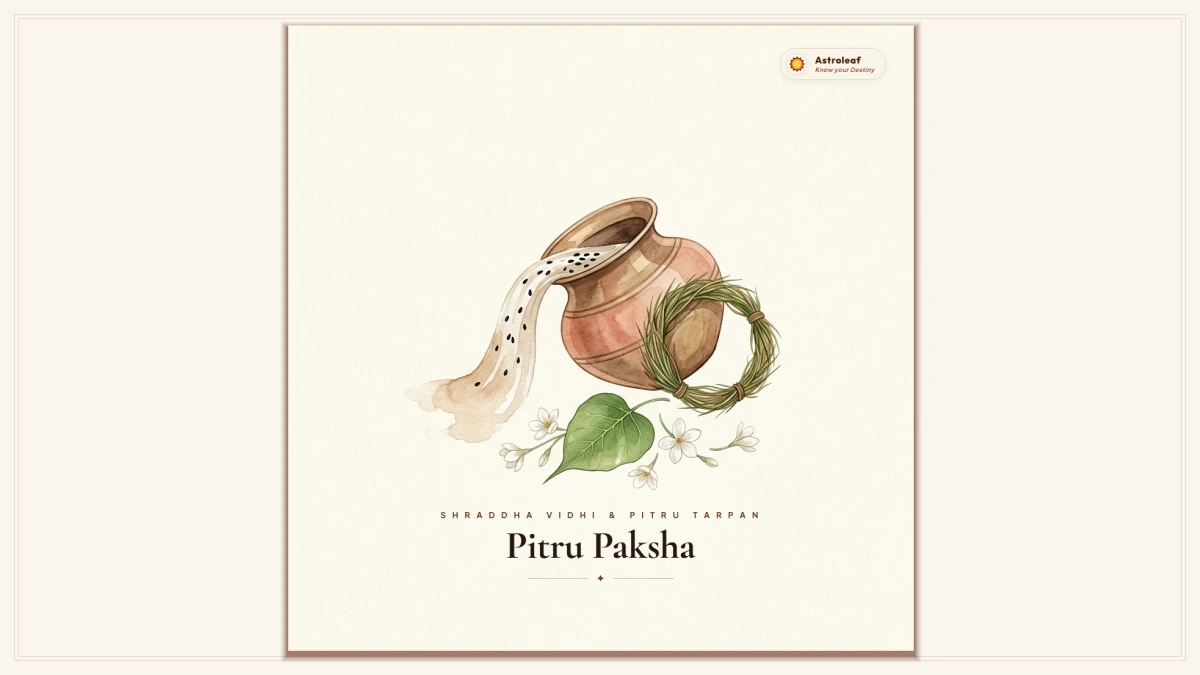
Tarpan is the sacred act of gratifying ancestors with pure water, black sesame seeds (Kala Til), and Kusha grass. The performer sits on a mat of Kusha facing South, wearing a Kusha ring (Pavitri) on the ring finger of the right hand. Offerings flow across the palm between the index finger and thumb, known as the Pitru Tirtha.
A Shraddha offering is incomplete without Panchabali, five sacred portions of food offered before human consumption:
- Gau Bali: Offered to mother cow on a clean sal leaf, invoking nourishment for universal creation.
- Shwan Bali: Offered to dogs, symbolizing the messengers of Yama, the lord of transition.
- Kaka Bali: Placed on rooftops for crows, regarded in Vedic texts as the direct messengers to ancestral realms.
- Deva Bali: Dedicated to fire and the presiding planetary deities of the pitrus.
- Pipilika Bali: Offered on clean soil to ants and micro-creatures, fulfilling the debt to all living beings.
Astrological Importance of Pitru Dosha & Remedies
In Vedic astrology, ancestral afflictions appear as Pitru Dosha in the horoscope, indicated when the Sun or Moon is severely afflicted by Rahu, Ketu, or Saturn in the 9th house (Bhagya Bhava) or 5th house (Purva Punya Bhava). Unaddressed ancestral unrest often manifests as unexplained financial blockages, chronic health debilities, delays in childbirth, or recurrent domestic strife.
Performing Shraddha during Pitru Paksha with authentic sincerity dissolves these generational blockages. As affirmed in the Markandeya Purana, pleased pitrus bestow longevity, intellect, wealth, righteous progeny, and spiritual liberation upon their lineage.
Frequently Asked Questions
What are the dates for Pitru Paksha in 2026?
Pitru Paksha begins on Saturday, September 26, 2026, with Bhadrapada Purnima Shraddha, and concludes on Saturday, October 10, 2026, with Sarva Pitru Amavasya (Mahalaya Amavasya).
When is Matri Navami in 2026?
Matri Navami falls on Sunday, October 4, 2026. It is dedicated exclusively to performing Shraddha for mothers, grandmothers, and departed married women of the household.
What if I do not know the exact death date of my ancestor?
If the exact lunar tithi of death is unknown, Shraddha can be observed with complete efficacy on Sarva Pitru Amavasya (October 10, 2026). Rites performed on this concluding day appease all departed lineage members universally.
Why should Shraddha be performed only in the afternoon?
According to Vedic scriptures, morning is reserved for deities, noon belongs to ancestors, and twilight belongs to elemental spirits. Kutup and Rohina muhurats in the afternoon (Aparahna Kaal) represent the precise celestial window when ancestral offerings are received.